The Death of One-Off Content: Why Social Media Strategy Needs More Than Reach
For years, social media strategy has been dominated by one question:
"What should we post next?"
It's a question that seems harmless on the surface, but it has quietly shaped how most brands approach content. Instead of building long-term assets, many companies have fallen into a cycle of creating isolated posts designed to generate immediate engagement.
A trend today, a meme tomorrow, an industry hot take next week, an infographic the week after...
Each piece of content is judged independently, optimized for short-term performance, and quickly forgotten once it disappears from the feed.
The result is a content strategy that can generate awareness but struggles to create something far more valuable: retention.
The Awareness Trap
Most brands are producing content that is optimized for discovery. There's nothing inherently wrong with that, awareness matters, but a business cannot grow if new people never encounter it.
The problem emerges when awareness becomes the entire strategy. Many social media teams spend countless hours monitoring trends, analyzing competitors, and searching for the next idea that might generate reach. Every week starts with a blank slate, and every month feels like starting over.
The content performs, but the audience rarely remembers who created it.
Think about how many viral posts you've seen in the last thirty days. Now ask yourself how many brands you actually remember creating them.
The gap between those two numbers explains why so many businesses struggle to convert attention into loyalty.
A post can generate hundreds of thousands of impressions and still create almost no long-term value for a brand.
Why? Because impressions are temporary. Recognition, on the other hand, compounds.
When someone sees your content repeatedly and begins associating specific ideas, visuals, characters, or formats with your company, your content starts building equity. Every new post strengthens the memory of previous ones.
Without that consistency, each post is forced to succeed on its own. It's the difference between building a house brick by brick and throwing individual bricks into a field hoping one of them becomes valuable.
The Rise of Recurring Content
The strongest content creators on the internet rarely rely on isolated posts. Instead, they create recurring formats:
YouTube creators build shows.
Podcasters build segments.
Media companies build franchises.
Entertainment brands build universes.
Audiences become attached to familiar experiences. They return because they know what they're getting, even when the specific episode or post changes.
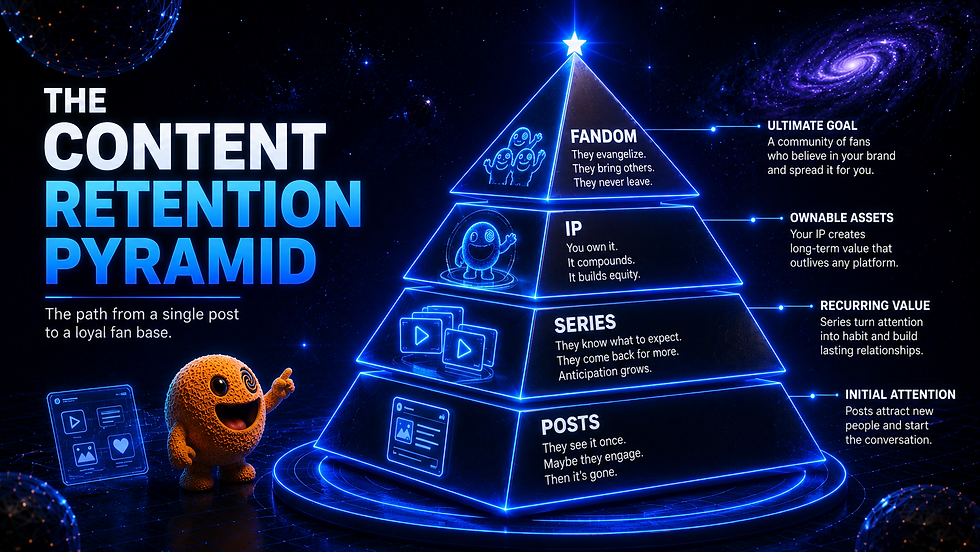
This is where many B2B brands fall behind: They publish content, but they don't create recurring intellectual property. Their audience may like individual posts, but they never develop anticipation for what comes next.
A content series changes the relationship between creator and audience. Instead of every post introducing itself from scratch, each new piece benefits from the momentum of everything that came before it.
The audience recognizes the format, they understand the premise, and they know what to expect. Most importantly, they want to see the next installment.
This creates a powerful shift from awareness to retention. A trend may attract someone once but a recurring series gives them a reason to come back. Over time, that return behavior becomes one of the most valuable assets a brand can own.
The Difference Between Awareness Content and Obsession Content
A modern social media strategy should include both.
Awareness Content
Awareness content is designed to reach new people.
Examples include:
Trend participation
Memes
Industry commentary
Reactive content
Newsjacking
Its primary job is discovery.
These formats help brands enter conversations and expose new audiences to their message.
Obsession Content
Obsession content is designed to deepen the relationship with existing audiences.
Examples include:
Recurring content series
Brand mascots
Original characters
Entertainment shows
Proprietary frameworks
Branded content universes
Its primary job is retention.
This content creates familiarity, anticipation, and emotional attachment over time.
Most brands invest heavily in awareness content while almost completely ignoring obsession content.
Why AI Changes Everything
Historically, building recurring content formats was expensive.
Creating characters, animated series, recurring shows, or branded entertainment required significant budgets and production resources.
That barrier no longer exists.
Today, AI allows companies to create visual worlds, virtual hosts, recurring characters, and scalable content systems at a fraction of the cost.
A business that once could only afford individual social posts can now build an entire content ecosystem.
This doesn't mean replacing strategy with automation, what it means is using AI can allow you to create the consistency and scale necessary to develop intellectual property that compounds over time.
The next generation of social media winners won't necessarily be the brands that post the most content, but brands that create the most recognizable content.
The brands that develop recurring formats.
The brands that build characters people remember.
The brands that create content audiences actively seek out rather than simply encounter.
In a world where everyone has access to content creation tools, the advantage shifts from volume to ownership.
Anyone can create another post, but very few companies are building intellectual property, and that's exactly why it matters.The smartest brands invest in both.
Final Thoughts
One-off content isn't disappearing completely. It will always have a role to play in awareness and discovery.
But relying exclusively on one-off content is becoming increasingly difficult in a crowded social media landscape.
The brands building long-term growth are shifting their focus from individual posts to recurring assets. They're creating formats instead of isolated content.
They're building recognition instead of chasing impressions.
Most importantly, they're giving audiences a reason to return.
That's the difference between getting attention and building a fandom, and in the AI era, fandom may be the most valuable marketing asset a business can own.


Comments